

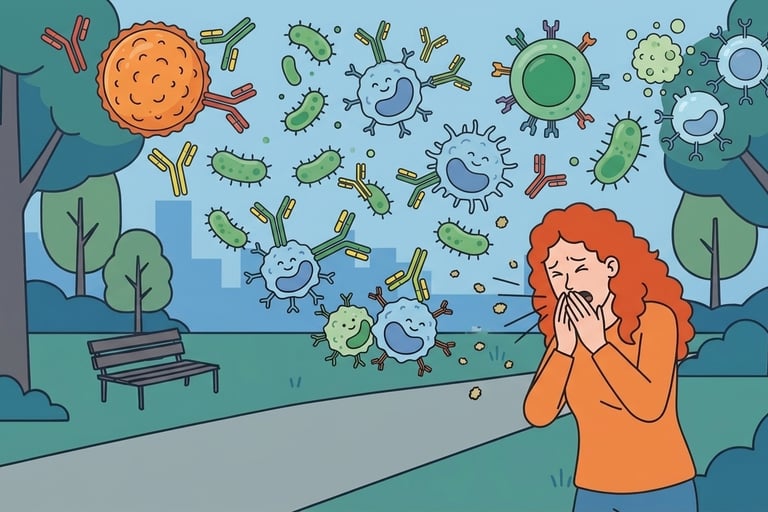
Allergies = Immune Dysregulation
(Not Just “Sensitivity”)
The immune system is designed to react → resolve → return to baseline. In many chronic allergy patterns, the system reacts—but doesn’t reliably “turn off,” so symptoms persist or reappear quickly.
The Th1 ↔ Th2 “Scale” (Conceptual but Helpful)
Think of the immune response as having different “modes.” In simplified terms, Th1 is often discussed in the context of intracellular defense and acute inflammatory clearance, while Th2/type 2 responses are linked to parasite defense, mucus, eosinophils, and IgE—the classic allergy pathway.
In allergic disease, research repeatedly ties symptoms to type 2 cytokines (IL‑4/IL‑5/IL‑13) and IgE biology. When the immune system gets stuck in a Th2-leaning loop, downstream effects can include mast cell activation and recurrent histamine-driven symptoms. Which are the typical allergy symptoms that people experience.
Inflammation Isn’t the Enemy—Poor Resolution Is
Acute inflammation is protective. The real problem in chronic allergy patterns is often impaired resolution: repeated exposures, ongoing antigen input, and weak regulatory signaling mean the body never fully returns to baseline.
This “incomplete recovery” frame is empowering, because it shifts the goal from “eliminate inflammation” to support better regulation, tolerance, and recovery.
The Gut–Immune Axis: The Foundation Most People Miss
Your gut isn’t just a digestion tube—it’s a major immune interface. Gut-associated lymphoid tissue (GALT) is central to immune surveillance and homeostasis at the largest antigen-exposure surface in the body.
The microbiome helps train immune tolerance and influences allergic disease risk. Reviews in this area describe how microbiome disruption can contribute to breakdown of tolerance and increased allergic tendency. Food-allergy-focused reviews similarly emphasize microbiome links to tolerance mechanisms.
Practical takeaway: if tolerance is partly trained in the gut ecosystem, then gut imbalance can make the immune system more trigger-happy elsewhere.
Histamine + Mast Cells: Why Symptoms Cluster (Sinuses, Skin, Head, Gut)
A huge portion of “allergy misery” is mediated by mast cells releasing chemical messengers—especially histamine. That can show up as congestion, itching, rashes, headaches, and food-related reactions.
Histamine isn’t automatically bad—it’s a normal signaling molecule. Trouble starts when histamine load exceeds histamine clearance. One important gut-related clearance pathway involves diamine oxidase (DAO); low DAO activity is associated with histamine intolerance and “allergy-like” symptoms (often GI symptoms and migraines/headaches among others).
A gut nuance: microbial histamine load
Some bacteria can produce histamine (well documented in food contexts). Reviews note histamine-producing bacteria including Morganella and other Enterobacteriaceae. Work specifically on Morganella morganii highlights histamine/biogenic amine production capacity.
This doesn’t prove “gut histamine producers cause all allergies,” but it supports a reasonable clinical idea: for some people, reducing overall histamine burden while improving gut tolerance may lower symptom intensity.
Why Meds Can Feel Like a “Band-Aid” (But Still Matter)
Antihistamines and steroids can be extremely helpful—sometimes essential—because they block symptom pathways (histamine receptors and inflammatory cascades). But they usually don’t address why the immune system is repeatedly choosing a Th2-heavy response in the first place. The possible side effects are the downside – which include headaches, dry mouth or throat, mild fatigue or drowsiness, nausea, dizziness, fast or irregular heartbeats, and trouble sleeping.
A balanced strategy often includes symptom control plus upstream work: immune tolerance support, microbiome restoration, and barrier resilience. (And for some allergies, allergen immunotherapy can be disease-modifying.)
Foods That Support Regulation (Simple, Real-World Picks)
These aren’t “cures,” but they can shift the terrain:
Quercetin-rich foods (onions, apples, capers): quercetin has been shown to inhibit human mast cell mediator release/degranulation pathways in research settings.
Vitamin C-rich foods (kiwi, bell peppers, citrus): human studies report reduced histamine levels after vitamin C interventions in certain contexts.
Omega-3s (fatty fish; flax/linseed): evidence is mixed in humans for allergy prevention, though mechanistic/animal data suggest potential anti-allergic effects in rhinitis models.
Polyphenols + fibers (if tolerated): microbiome-supportive patterns matter because microbiome balance is linked to allergy/tolerance.
Spotlight: There are multiple physician grade supplements designed to help support a balanced immune response, rather than simply blocking symptoms after they start. These formulas often focus on regulating histamine activity, promoting respiratory and sinus comfort, and strengthening the body’s natural barriers like mucous membranes. Many also include antioxidants and key vitamins to help reduce inflammation and support overall immune resilience. While results can vary, this type of approach aims to help the body respond more calmly to common triggers like pollen, dust, and environmental irritants—offering a complementary path for those looking to go beyond traditional allergy relief.
Gut health is seen as a cornerstone of overall wellness, with a strong focus on the balance of the microbiome—the community of beneficial bacteria living in the digestive tract. When this balance is disrupted, it can influence everything from digestion to immune function and even inflammation levels throughout the body. By supporting the gut with targeted nutrition, lifestyle changes, and sometimes probiotics or digestive support, the goal is to restore harmony in the microbiome and promote better whole-body health from the inside out.
What to do this week (simple action box)
Pick 1–2 “mast-cell friendly” foods daily: onions/apples or berries + olive oil.
Add a Vitamin C anchor food daily (kiwi or bell pepper are easy wins).
Support the gut with tolerable fiber (start low; avoid “hero doses” if you bloat).
Track patterns for 7 days: congestion, skin itch, headache, and food reactions—look for histamine-style clusters.
Bottom line
Allergies aren’t just a reaction to what’s in the air or on your plate—they’re often a sign of a system-wide immune pattern that can be influenced over time. At the root is the body’s regulatory balance (often described as the Th1/Th2 axis), the health of the gut–immune barrier, and the makeup of the microbiome that helps train tolerance. When those systems are supported, the goal isn’t to “shut down” the immune response—it’s to help your body respond appropriately, then fully resolve, returning to baseline instead of staying stuck in chronic inflammation and symptoms.
If you’d like to learn more, contact our office to discuss the root factors that may be driving your allergy symptoms—and how we can help you create a personalized plan for lasting relief.Gut Microbiota and Food Allergy: A Review of Mechanisms… PubMed Central (PMC). URL: https://pmc.ncbi.nlm.nih.gov/articles/PMC12472630/ Accessed April 18, 2026.
The Microbiome and Development of Allergic Disease. PubMed Central (PMC). URL: https://pmc.ncbi.nlm.nih.gov/articles/PMC5378446/ Accessed April 18, 2026.
Host-microbiome interactions in atopic and allergic diseases. ScienceDirect. URL: https://www.sciencedirect.com/science/article/pii/S2468202023000359 Accessed April 18, 2026.
Gut-associated lymphoid tissue: a microbiota-driven hub of B cell… PubMed Central (PMC). URL: https://pmc.ncbi.nlm.nih.gov/articles/PMC11227984/ Accessed April 18, 2026.
Prevalence of IgE-mediated allergy and evaluation of Th1/Th2… PubMed Central (PMC). URL: https://pmc.ncbi.nlm.nih.gov/articles/PMC4565842/ Accessed April 18, 2026.
Type 2 immunity in allergic diseases. Nature (Cellular & Molecular Immunology). URL: https://www.nature.com/articles/s41423-025-01261-2 Accessed April 18, 2026.
The relative contribution of IL-4 and IL-13 to human IgE synthesis… Journal of Allergy and Clinical Immunology (JACI). URL: https://www.jacionline.org/article/S0091-6749%2897%2970276-8/fulltext Accessed April 18, 2026.
Diamine oxidase deficiency implications for health… PubMed. URL: https://pubmed.ncbi.nlm.nih.gov/40865824/ Accessed April 18, 2026.
Role of Marine Bacterial Contaminants in Histamine Formation… PubMed Central (PMC). URL: https://pmc.ncbi.nlm.nih.gov/articles/PMC9227395/ Accessed April 18, 2026.
Histamine and Biogenic Amine Production by Morganella morganii… ScienceDirect (PDF). URL: https://www.sciencedirect.com/science/article/pii/S0362028X22040145/pdf Accessed April 18, 2026.
Intravenous infusion of ascorbic acid decreases serum histamine… PubMed. URL: https://pubmed.ncbi.nlm.nih.gov/23666445/ Accessed April 18, 2026.
Histamine and ascorbic acid in human blood. PubMed. URL: https://pubmed.ncbi.nlm.nih.gov/7365537/ Accessed April 18, 2026.
Quercetin Is More Effective than Cromolyn in Blocking Human Mast Cells… PLOS ONE. URL: https://journals.plos.org/plosone/article?id=10.1371/journal.pone.0033805 Accessed April 18, 2026.
Quercetin Attenuates… Mast Cell Degranulation… PubMed Central (PMC). URL: https://pmc.ncbi.nlm.nih.gov/articles/PMC11468308/ Accessed April 18, 2026.
Omega 3 and 6 Oils for Primary Prevention of Allergic Disease. PubMed. URL: https://pubmed.ncbi.nlm.nih.gov/19392990/ Accessed April 18, 2026.
Dietary Omega-3 Fatty Acid Dampens Allergic Rhinitis… PubMed Central (PMC). URL: https://pmc.ncbi.nlm.nih.gov/articles/PMC6950470/ Accessed April 18, 2026.
Astragalus membranaceus, Nigella sativa, and Perilla frutescens as… PubMed Central (PMC). URL: https://pmc.ncbi.nlm.nih.gov/articles/PMC11352820/ Accessed April 18, 2026.
Two cases of anaphylaxis caused by perilla seed. Journal of Allergy and Clinical Immunology (JACI). URL: https://www.jacionline.org/article/S0091-6749(06)00575-6/fulltext Accessed April 18, 2026.
Allergies are commonly framed as “my body doesn’t like pollen/foods.” A more useful model is that allergic disease reflects immune system patterning, often skewed toward type 2 (Th2) immunity—a program strongly associated with IL‑4, IL‑5, IL‑13 signaling and IgE-related responses